
Mesa County Recent Arrests
For any custodial arrest, the Mesa County Blotter Reports page is the strongest cross-agency starting point. Its Booking Summary covers people booked into the Mesa County Detention Facility. That is over the preceding report window. The jail takes arrestees from local, state, and federal agencies working in the county. So the summary runs wider than a Sheriff-only incident list. It will not show every citation or field release, though. Match each tool to the question at hand. The Booking Summary is a dated snapshot. The locator tracks current custody, and police resumes describe agency activity. Their dates are not interchangeable.
| Official view | Window | Best use |
|---|---|---|
| 24 Hour Arrests | Prior report window | Newest detention bookings |
| Arrest Log | Dated reports | Multi-day agency research |
| Inmate Locator | Current custody | Confirm who is held now |
| VINELink Check | Participating custody feed | Status alerts for one person |
The official report index shows how Mesa County presents its two daily report types.
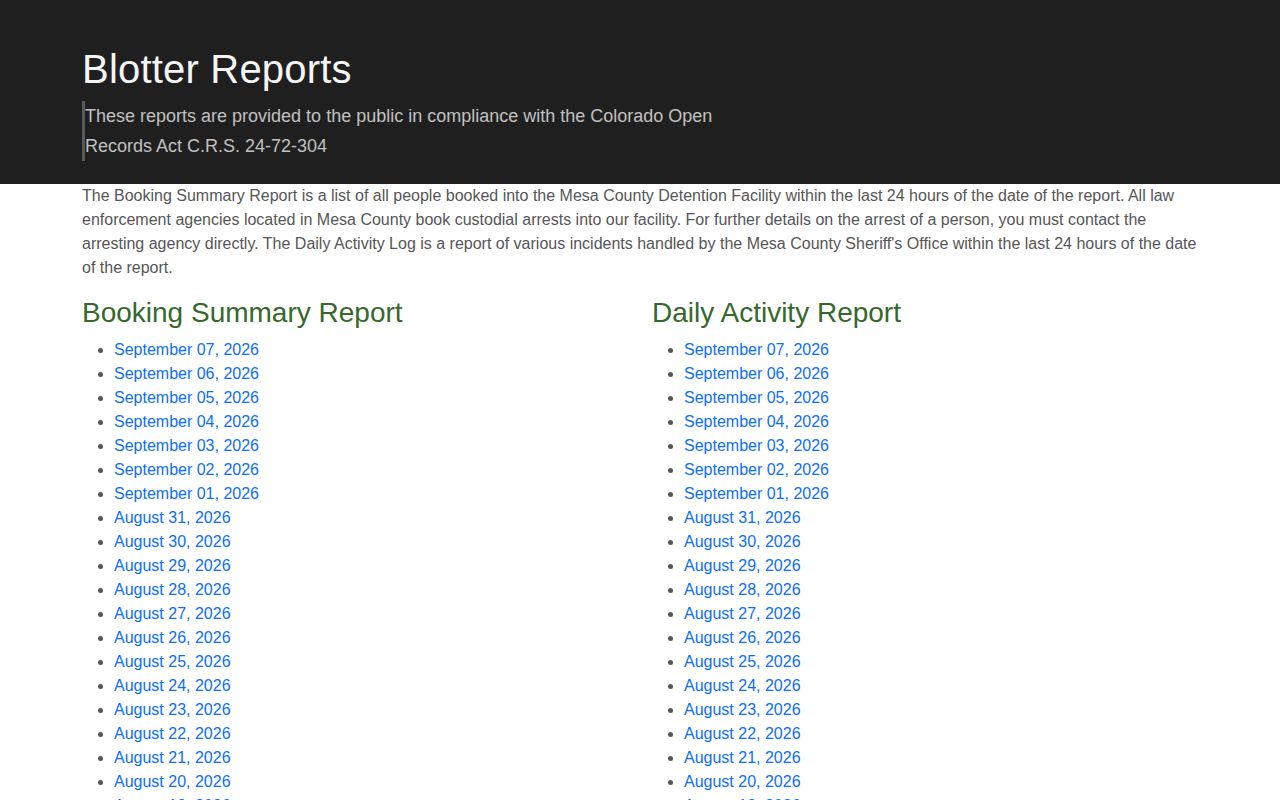
The dated links split detention intake from Sheriff incident activity. They also keep a short public archive.
When Mesa Arrest Reports Post
Mesa County defines the Booking Summary as the 24 hours before the report date. The PDFs print at roughly 10 a.m. So treat each one as a morning snapshot rather than a live feed. Someone booked after generation waits for the next day's report. The public index holds about 30 dated days. But that visible span is not a legal retention period.
Late-night arrest? Check the newest PDF first, then the roster. If neither settles it, call MCSO with the full name and an approximate booking time. The 24 Hour Arrests page walks through the same-day sequence. One empty snapshot does not mean no arrest occurred.
Search the Mesa Arrest Roster
The MCSO Inmate Locator answers the current-custody question. It takes a last name, date of birth, or booking number. Search with the most exact identifier you have. Then compare any hit against the dated booking report. The page states no refresh interval and promises no photo in every result.
| Field | Use | Caution |
|---|---|---|
| Last name | Broad name search | May return similar names |
| Date of birth | Narrow an identity | Must be exact |
| Booking number | Find one intake | Requires the identifier |
Use the systems in order:
- Note the exact name, booking date, and number from the Booking Summary.
- Search the locator by booking number, or by name and birth date.
- Read custody and bond fields as a current snapshot.
- Use VINE for alerts and the court docket for later hearings.
Someone released can drop off the roster while the agency keeps the booking file on hand. A negative result settles nothing about the case.
The official inmate locator shows the county's accepted search fields.
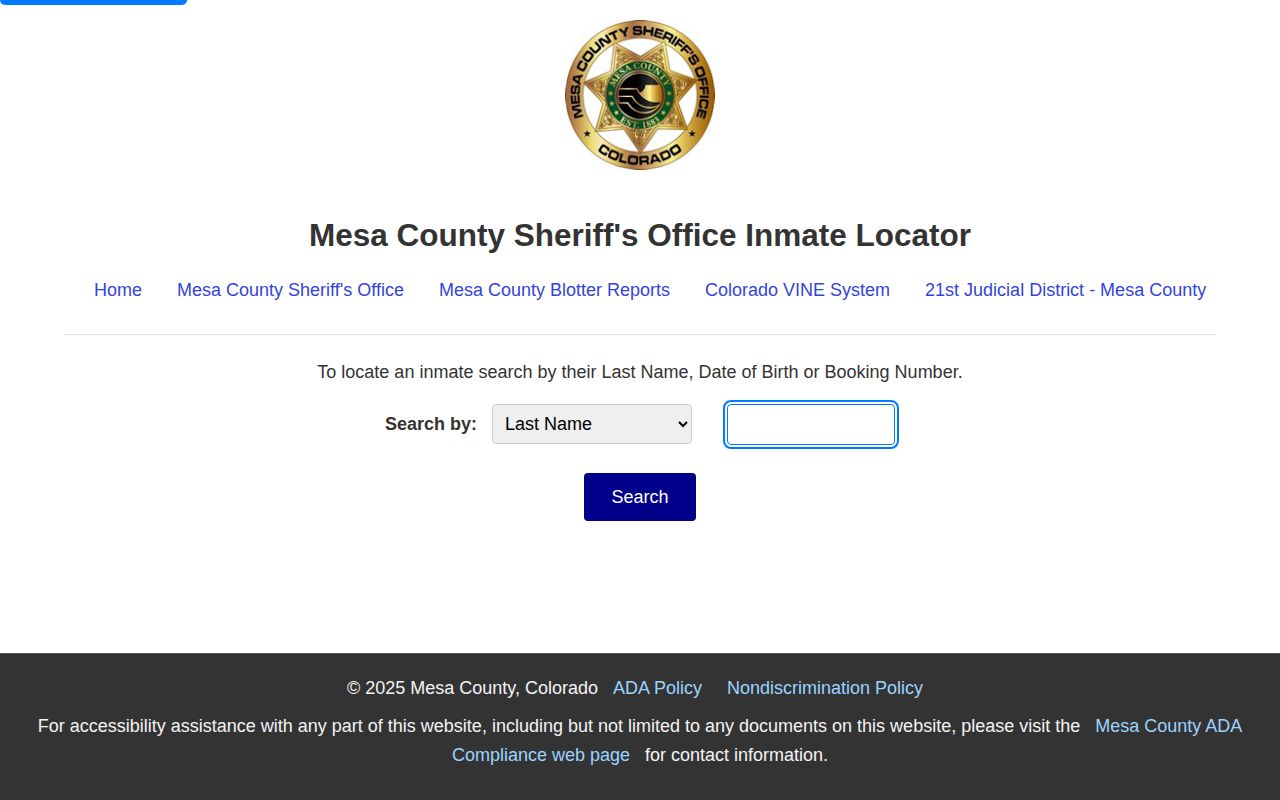
Its links tie custody research to the county blotter, VINE, and the 21st Judicial District.
Quick Book Arrests in Mesa
Why would a booking photo exist with no lasting roster entry? The Sheriff's Quick Book article explains it. Participating agencies bring a person in for a photograph and fingerprints. They then release them on bond with court instructions. Not every arrest goes this route.
The booking transaction is real even when the custody window is brief. Check the PDF, the release paperwork, and the court docket. A missing inmate result does not erase the arrest or decide the charge.
Where Mesa Arrests Are Published
Start with official channels. News and commercial pages may omit events, keep old images, or use different date ranges.
| Channel | Photos | Status |
|---|---|---|
| Booking Summary | PDFs may contain an image column | Official dated intake report |
| Inmate Locator | Not promised on search screen | Official current custody |
| CRIMEWATCH Arrests | Some posts have photos | Official but selective |
| JunctionNow | Weekly images may appear | Unofficial news |
| Mugshots.com Mesa | Older image pages | Unofficial and potentially stale |
| Jail Exchange | Directory varies | Unofficial link guide |
Busted Newspaper, Arrests.org, RecentlyBooked, and Mugshots.zone list no confirmed Mesa local section. Their general pages do not establish Mesa County coverage. CRIMEWATCH adds an official app and email alerts, but its incident posts are no full jail feed.
Recent Arrests by Mesa City
One county jail serves a mixed agency map, and publishing varies by city. Grand Junction posts a preceding-24-hour police resume. Fruita publishes weekly patrol resumes. Palisade has no official public arrest blotter, so county booking records and a town request are the fallback.
- Grand Junction Recent Arrests connects GJPD reports with county custody.
- Fruita Recent Arrests explains weekly resumes and police requests.
- Palisade Recent Arrests uses the county feed and town records route.
A city summons may never create a jail entry. A county booking can also come from an agency with a limited public feed.
Mesa County Arrest Record Fields
A Mesa County booking record shows what happened at intake. Identity details, charges, bond amounts, and a booking photo fill most fields. Certain content may be redacted, so weigh it against the court file.
| Field | Meaning |
|---|---|
| Name and birth date | Identity details |
| Booking number and date | Intake identifier and time |
| Arresting agency | Agency that initiated custody |
| Charge | Charge entered at booking |
| Bond | Release condition at that stage |
| Image | Booking photograph if included and releasable |
- Booking
- Jail intake recording identity, charges, fingerprints, and related data.
- Bond
- A court-set condition that may permit release.
- Disposition
- The court outcome, such as dismissal, plea, acquittal, or conviction.
- Redaction
- Removal of protected information before release.
Mesa Arrest Mugshots and Photos
Booking photographs appear in the official summary PDFs or can be requested from MCSO. The inmate search does not promise a photo with every result. After a state prison sentence, the Colorado DOC Offender Search may show an offender image. CDOC is not a recent county booking source.
One Colorado statute limits this. Colorado Revised Statutes § 24-72-305.5 bars obtaining a booking photo when the buyer knows it will be posted where removal requires payment. MCSO's 2024 schedule listed $3 per mugshot, plus separate report, research, redaction, and digital-delivery charges. Confirm current fees first. No booking-photo gallery is hosted here.
Request a Mesa Arrest Record
Use the MCSO Criminal Justice Records Request Form for a Sheriff booking file or photograph. Give the booking or incident number, date, nature, location, and person. A narrow request is easier to route and price.
- Identify whether MCSO or a city police agency created the desired record.
- Submit the Sheriff form for jail intake material and the city route for its case file.
- Request an estimate and confirm current fees.
- Review any redactions or identification instructions.
- Use the court file for prosecution and disposition.
Filing restrictions touch a long list of protected material. CCIC, CBI, NCIC, and FBI databases are covered, along with medical data, victim details, minors, and open investigations. The Mesa County CORA portal handles county records. Court criminal records go elsewhere.
Mesa County Sheriff’s Office215 Rice Street
Grand Junction, CO 81501
970-244-3500
Non-emergency: 970-242-6707
Colorado Arrest Records Law
Colorado law splits criminal justice records into two camps. Records of official action get one treatment, and everything else gets another. The Attorney General's CORA overview walks through how that divide works. Mesa County's own blotter points to C.R.S. § 24-72-304 as its authority. Still, some material stays out of reach. Juvenile records can be withheld, along with victim details. Protected database entries and active investigative files may be blacked out too.
A booking photo staying online says nothing about how long the county keeps it. The Mesa County Sheriff's Office publishes no retention schedule for booking photos. So do not read the visible report span as a destruction rule. For any older Mesa County arrest record, ask the custodian which record series it belongs to. Ask what retention authority governs it. Ask whether it was transferred somewhere else.
Seal a Mesa Arrest Record
Start with the Colorado Judicial Seal My Case materials. Do this if a Mesa arrest record is eligible. Sealing a case in court is only step one. Agencies must update their own files, and private sites operate on a separate track entirely. Keep the court order handy, along with the exact page URL. Use both when you ask a publisher or search engine to fix results.
RecentlyBooked offers free documentation help in general, but it has no Mesa section. Mugshots.com says it will consider free documentation. Covered grounds include sealing, expungement, identity errors, and certain dispositions. Neither policy is a government promise. Skip any paid removal offer.
Mesa Arrest Warrants and Wanted Posts
The MCSO Warrants page and Colorado Most Wanted post selected wanted-person leads. Neither is a complete warrant database you can search by name. MCSO's records form includes an active-warrant-check section, while a court-issued status belongs with the court itself. Verify through the records route, the court, or an attorney, and arrange a lawful response that way. Never approach a wanted person. Call 911 in an emergency; otherwise the official tip form takes non-emergency information. The official warrant posts show the selective format these agencies use.
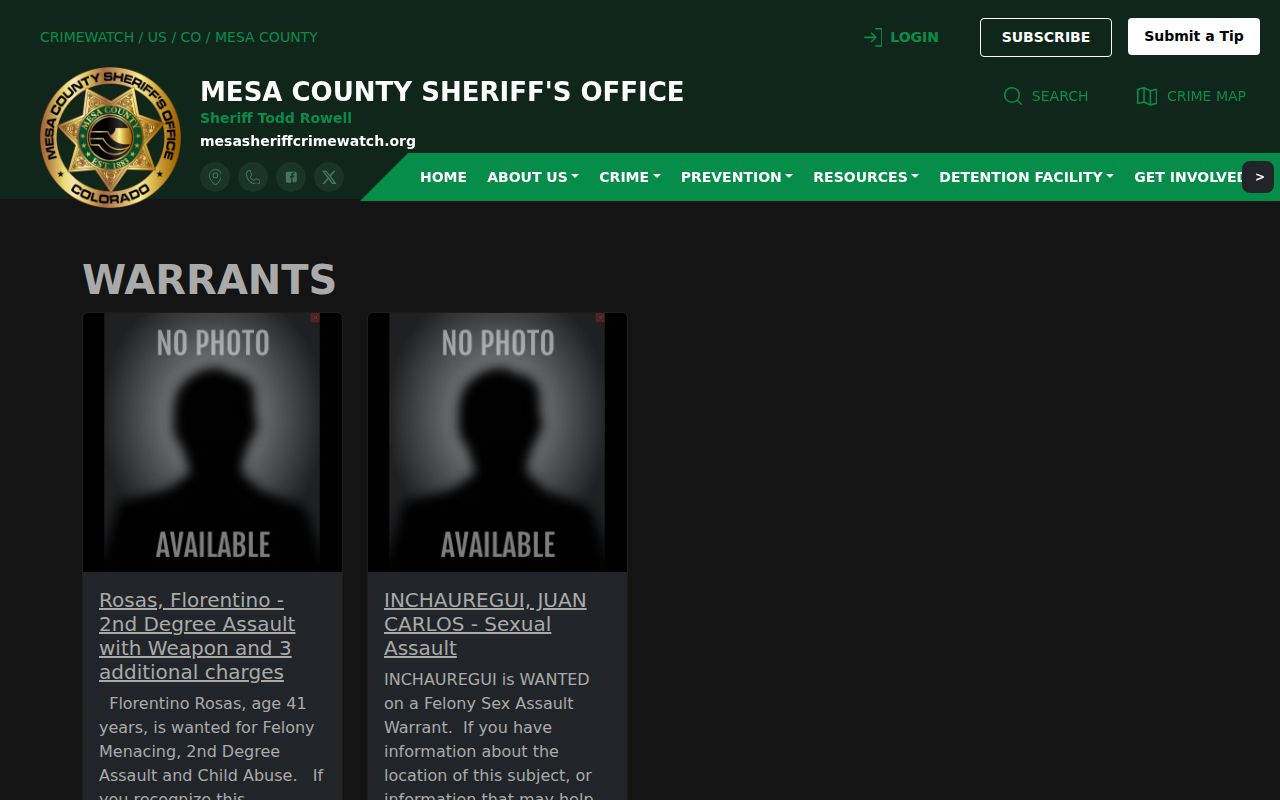
Use these posts as public leads, not as a complete warrant verification portal.
After a Mesa County Arrest
Booking opens the jail record. Court filings then carry the case forward. Mesa County says a judge sets initial bond within 48 hours. That clock belongs to the judiciary, though, not the roster. Bond, release, PDF publication, and roster display all run on their own schedules.
The Mesa County docket search lets you filter hearings. Filters include county, court, date, case number, and party. For the local court route, the 21st Judicial District page is the place to start. A docket still is not the full case file.
The official docket view shows how research continues after booking.
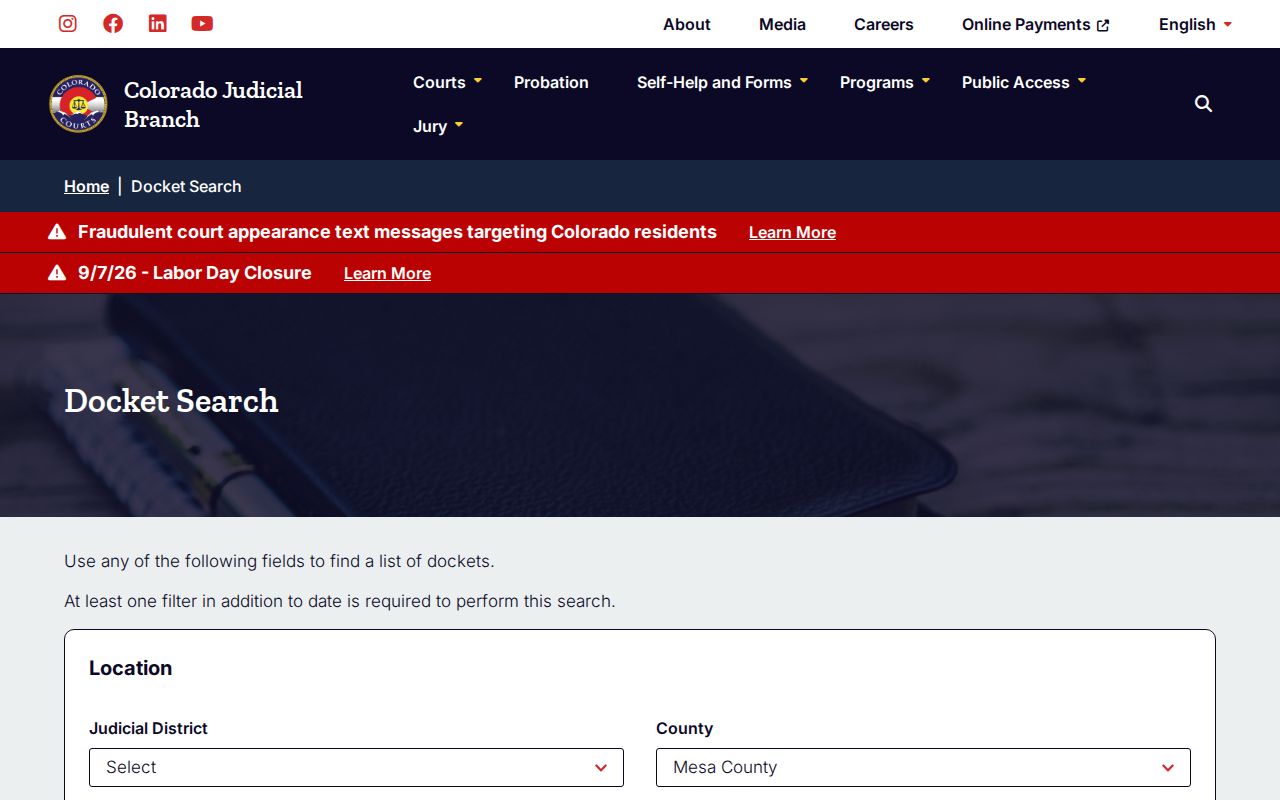
The court layer separates the initial allegation from later hearings and outcomes.
Mesa Bond Timing After Arrest
Bond timing and booking are separate things. Mesa County puts initial bond setting in a judge's hands within 48 hours. After an arrest, a person might go through Quick Book, post bond, or stay held. Otherwise the name shows up on the next report. That window describes a court process. It is not the Booking Summary schedule or how long a name sits on a roster.
Treat every bond figure as a snapshot. The jail records what existed at intake; a later court order controls from then on. Set the locator beside the docket and ask the clerk for the official file. A missing roster name proves nothing about a bond.
Mesa Arrest Requests and Redactions
Custodian review is built into how MCSO handles requests. Its form flags CCIC, CBI, NCIC, and FBI information as protected. Medical details, victims, minors, open investigations, and public-interest limits get named too. A broad request can come back redacted, partly withheld, or accompanied by a price estimate.
Be specific instead. Name the exact booking photo, intake record, incident report, or warrant check you want. If a Grand Junction, Fruita, or Palisade officer made the arrest, the city may hold the investigation. MCSO holds the jail booking. Neither file has to contain the whole case.
Can a photo be withheld? A request never guarantees release. The custodian applies Colorado law and can strip protected content. Whatever the answer, the response should point to your next step.
Mesa Charges Versus Court Outcomes
A Booking Summary entry and a court record measure different moments. One reflects intake at the jail. The other reflects what prosecutors filed, what judges decided, and how the case resolved. It might end by dismissal, acquittal, plea, or conviction. Even the wording of an offense can shift between the two.
Identity matters here. Similar names and stale private pages produce false matches. Write down the booking and case numbers, then compare the issuing offices. For how the case truly ended, the disposition is the record to trust. The full path runs arrest, booking, roster or release, and advisement. Then come a filed case, disposition, and possible sealing.
Mesa Crime Counts Are Not Arrests
MCSO crime statistics cannot be turned into booking totals. Its 2025 article tracks property-crime trends and case closure, which count different events than jail intake. One incident might involve several people, no custodial arrest, or enforcement that comes later. A booking can also trace back to an agency outside the Sheriff's own numbers.
Match each source to what it actually counts. The Booking Summary covers intake during its window. Daily Activity logs Sheriff incidents. City resumes cover city agencies, and dockets cover hearings. Keeping those straight stops crime trends from masquerading as recent-arrest totals. The official MCSO crime page is itself a selective information channel.
Its reports add context, while the Booking Summary remains the cross-agency intake view.
Older Mesa Arrest Records
Chasing an older Mesa County arrest record means starting with MCSO. The PDFs you can see are not the place to start. Give the office a date, a booking number, and a name. Say exactly what you want. Then ask where the item lives now. It could be held in house, transferred, or filed in a different series. Some items are destroyed under an approved schedule. The arresting city may keep its own case file too, so ask there as well.
The Colorado State Archives search opens a different door. Its finding aids hold prison registers, indexes, files, and some inmate photographs. Those reach back through the state's history. They are not county jail bookings, though. Prison custody and Mesa booking custody are two separate record streams.
Sealing takes follow-up work. A court order, an agency database, a cache, and a private page can all update on their own schedules. Begin with the court and the originating office. Then use the free correction routes.
Custody Beyond Mesa Arrests
Once a state sentence kicks in, the person transfers. The Colorado DOC Offender Search becomes the right tool. CDOC may show a photo, but it tracks prison custody, not fresh county bookings. Colorado VINE states plainly that its county-jail service does not report CDOC status.
Two federal locators fill other gaps. The BOP Inmate Locator covers federal prison custody without photos. The ICE detainee locator handles immigration detention. Neither one tells you whether Mesa County made the original arrest.
Verify a Mesa Arrest Identity
A careful match takes more than a name. Start with the booking number. That identifier belongs to one intake only. Then compare the full name, date of birth, booking date, arresting agency, and charge description across the PDF and the locator before you move to a court search. A stray spelling difference, a middle name, a suffix, or a reused family name can tie the wrong person to a Mesa arrest record fast.
Dates carry different meanings here. Arrest time, booking time, report date, PDF print time, release time, hearing date, and article publication date can each sit apart. A weekly news recap may run days after intake. A morning Booking Summary often describes the prior calendar day. The live roster can shift before either publication is even opened, so write each date down with its source instead of merging them into one timeline.
When the public interface gives no clear match, ask the records office to search a limited date range. Share only what locates the record. The office may want identification before releasing protected material, and fees can apply if staff must research or redact a long report.
Mesa Booking Channels Compared
What if official sources disagree? Trust whichever office owns the fact. MCSO controls its detention and booking data, and a city police department controls its incident report. The court controls its docket. CDOC controls prison status. VINE sends notices from participating custody feeds. When a time-sensitive custody question stays murky, call the responsible office directly.
News helps you find an event. But it should not settle custody. JunctionNow publishes some weekly booking coverage. KKCO, KJCT, and the Daily Sentinel report selected arrests. Editorial dates and photo choices never define the official booking window. The same wariness fits commercial archives. Be especially careful with pages that are years old or lack any Mesa-specific section.
The matter may matter to a court or records process. In that case, save a copy of the official response. Online pages refresh, and PDFs rotate off a short index. Private search caches can lag a correction. The originating agency stays the best place to ask. It can explain what a field meant on the day it was created.
Mesa County Sheriff’s Office Location and Directions
Public Record Search
Sponsored Results