
How Grand Junction Arrests Work
Grand Junction is Mesa County's seat and its largest city. It counted 65,560 residents in the 2020 Decennial Census. The Grand Junction Police Department handles most city enforcement. When GJPD officers investigate an event or make an arrest, they create the incident-level police record for it. A custodial arrest then enters the Mesa County Detention Facility booking system. That split shapes every search. The police department keeps its report and narrative. The Mesa County Sheriff's Office holds the jail intake record.
Not every police action ends in a jail stay. The GJPD Daily Resume can show a person arrested and released on a summons. It can also list a warrant served, a DUI event, or a custodial transfer to jail. A summons sends a person to court without ongoing detention. So a missing roster result never disproves a city arrest. Match the record to the question: city report, county intake report, live custody roster, or court docket.
Where Grand Junction Arrests Appear
Grand Junction has the clearest publication system of any city in Mesa County. Still, no single source answers everything. The GJPD resume gives city incident context. County systems track detention and custody. Court records show what happens next. Local news is selective, so treat it as a last stop after the government sources.
| Channel | Photo | Status | Best use |
|---|---|---|---|
| GJPD Police Blotter | No photo column in the sample | Official city source | Daily Resume arrests, summonses, incidents, and narratives |
| Mesa Booking Summary | Sample reports have an image area | Official county source | Custodial intake during the report window |
| MCSO Inmate Locator | Not guaranteed by the search page | Official county source | Current or still-indexed detention custody |
| MCSO CRIMEWATCH | Sometimes | Official, selective | Notable arrest posts, warrants, and agency alerts |
| JunctionNow and regional news | Varies | Unofficial | Event or weekly coverage that may lag or omit records |
Each source tracks a different custody state. A Daily Resume entry can reflect city enforcement with no detention attached. The Booking Summary proves intake happened. Still, it can lag as a custody indicator. For someone possibly still held, the live roster is the better tool.
Find a Grand Junction Booking
Lean on dates and identifiers before trusting a name search. City and county reports cover different windows, and a fresh booking can land after a PDF has already been generated. The county's 24 Hour Arrests page breaks down that report window in depth.
- Open the GJPD Police Blotter and select the Daily Resume whose report period covers the event, not merely the link's posting date.
- Check the county Booking Summary for detention intake. Read the booking date and arresting-agency field carefully.
- Search the MCSO locator by last name, date of birth, or booking number when the person may still be in custody.
- Request the GJPD incident record for police facts, or ask MCSO for the booking record and available photo.
- Use the Mesa County court docket and clerk for hearing or disposition information after filing.
An empty roster search can mean many things. The person may have been released or transferred. Some were processed through a short Quick Book hold. A spelling mismatch or a record that has not yet posted produces the same result. Quick Book can involve fingerprints and a booking photograph. Release may follow on bond, with court instructions. Mesa County law-enforcement agencies can use it, though not every case does.
Note: Match the name with date, agency, incident number, and court record before treating two entries as one person.
Grand Junction Police Arrest Records
The GJPD Records/Data Management Unit handles current requests. It routes them through the city's records process and NextRequest. Ask GJPD for the police report, event narrative, or city-held photograph. Ask MCSO for a booking record or booking photo. That applies once the person reached the detention facility. The two custodians can hold related but nonidentical files.
555 Ute Avenue
Grand Junction, CO 81501
970-549-5000
PDRecords@gjcity.org
Include the incident number if you know it. A focused request should also carry the event date, location, full name, and the exact item sought. The current GJPD page notes possible fees and redactions. An older official form listed copies at $0.25 per page and research after the first hour at $5 per quarter-hour. Confirm those rates before paying. Active cases and protected details may be withheld or redacted.
For a jail image or intake record, the county form is the better route. MCSO's dated fee schedule lists a mugshot fee. The amount and delivery method should be confirmed, since the schedule dates to 2024. The wider Mesa County treatment of official booking photos sits in the county mugshots section.
The official Grand Junction records page shows the city's current request entry point.
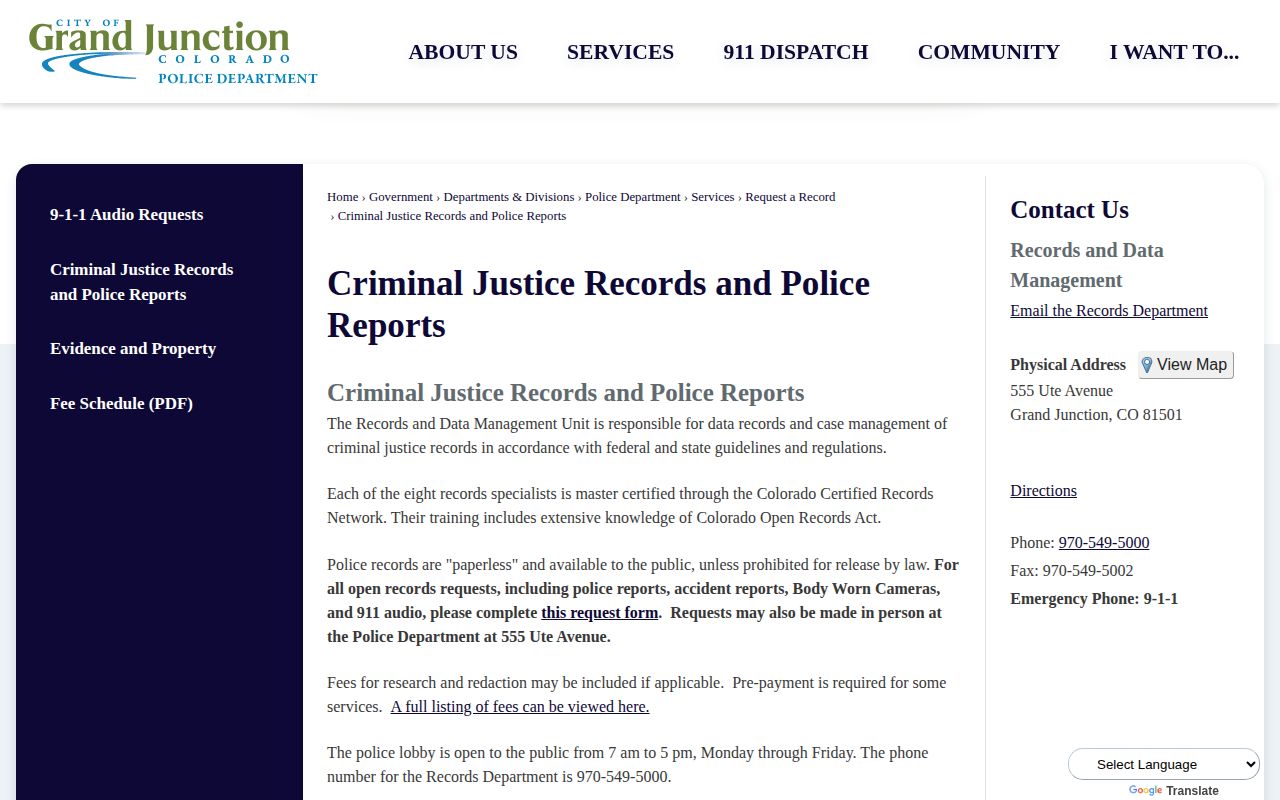
The official records page helps separate the city report route from the Sheriff's separate jail-booking process.
Grand Junction Daily Resume Timing
GJPD defines its Daily Resume as a recap of everyone arrested plus significant reported crimes over the preceding 24 hours. One report ran from 9:00:01 a.m. one day through 9:00:00 a.m. the next and appeared around 10:00 a.m. That timing describes a sample, not a promise. Each entry can carry an incident number and type, a short narrative, officer identifier, event date and time, and a general area. The archive shows weekend-style and other date gaps. Treat it as patchy rather than a full calendar. Read the period printed inside each PDF. Then turn to the county booking report when the narrative says the person went to jail.
The official GJPD blotter archive shows the dated Daily Resume links.
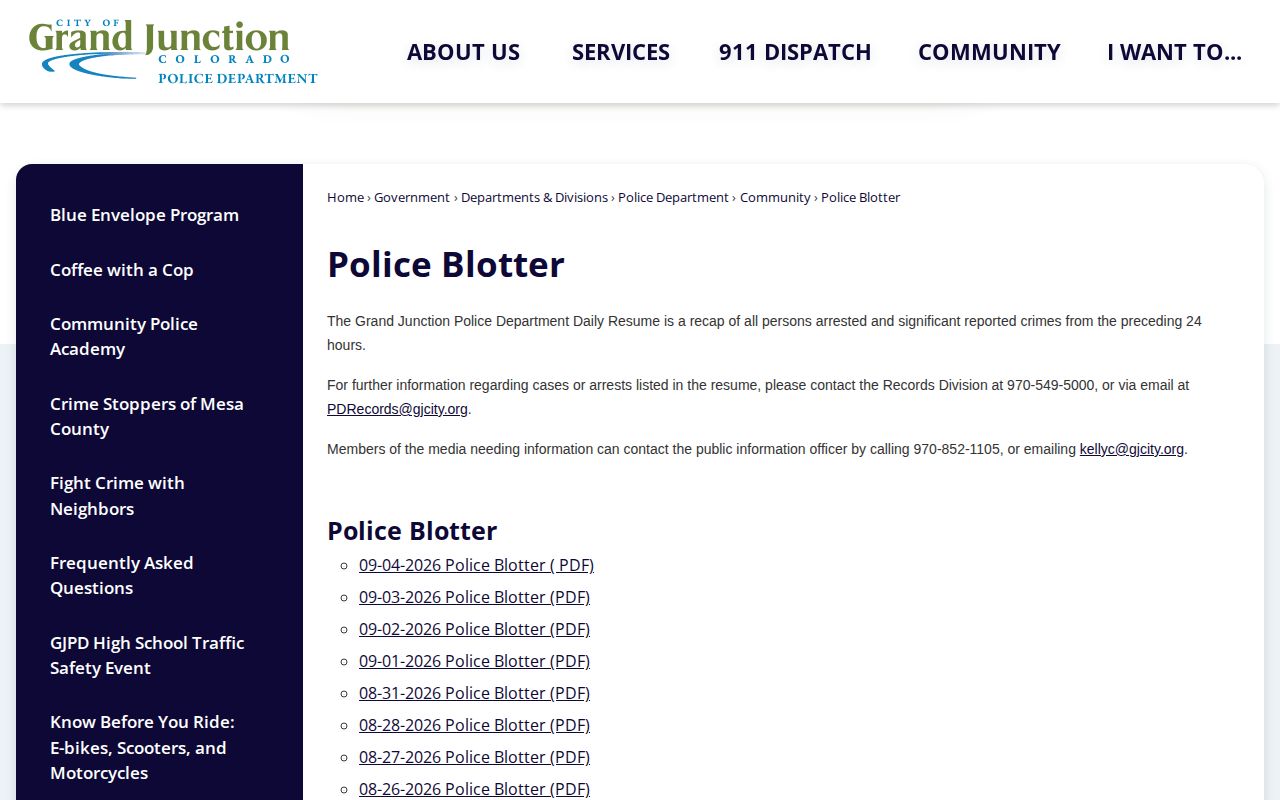
The blotter archive page makes the city reporting window and its dated gaps easy to spot. No booking photos are reproduced there.
Grand Junction Arrest Versus Custody
An arrest record and a custody status answer two different questions. The GJPD Daily Resume shows what city police handled. The Booking Summary covers who entered the Mesa County Detention Facility. It reflects the facility's prior report window. For anyone possibly still held, the inmate locator is the right tool. The Colorado Department of Corrections search starts to matter only after a state sentence and a transfer. So a fresh Grand Junction booking stays off it.
- Booking
- The jail intake step that records identity, time, agency, alleged charges, and other fields.
- Summons
- A direction to appear in court that may not create a current jail stay.
- Disposition
- The court's resolution, such as dismissal, plea, acquittal, or conviction.
- Transfer
- A move to another custody system, which can make a county roster entry change.
The Mesa County docket search can help locate hearings. It stops there. A calendar line is not an outcome, so the court file or the clerk is the place to confirm a disposition. For case-specific questions, the local court contact is the Mesa County Justice Center. Its official page lists the courthouse at 125 North Spruce Street in Grand Junction, phone 970-257-3640, and mesa.court@judicial.state.co.us. The state docket tool filters by county, courthouse, date, case number, party, and more. It is a hearing search, not an arrest archive. When the Daily Resume and a booking report word charges differently, the filed court documents show what the prosecutor pursued.
Records can also move past local custody. A state sentence may lead to a CDOC result. Federal prison and immigration detention use separate federal locators. Each system tracks its own population. None of those systems replaces the GJPD report. They answer where a person is held after a later transfer, not what city officers recorded at the start.
Grand Junction Arrest News Limits
Local outlets covering Grand Junction and the Grand Valley include KKCO 11, KJCT News 8, The Daily Sentinel, and JunctionNow. JunctionNow has run weekly county jail-booking articles with images. TV and newspaper stories cover what editors pick. A photo may appear, be missing, or arrive later from an agency. That coverage adds narrative context. It does not replace an official city report or a county booking record.
Older third-party pages also linger online after the official roster changes. Mugshots.com keeps a historical Mesa County section. Its age, scope, and accuracy are uncertain. Several other large aggregators carry no current Mesa County section. Official GJPD, MCSO, and court sources should lead every check. No private page proves current custody.
Grand Junction Police Department Location and Directions
Public Record Search
Sponsored Results